How painful experiences become stories about who we are—and how we begin to reclaim the rest of ourselves.
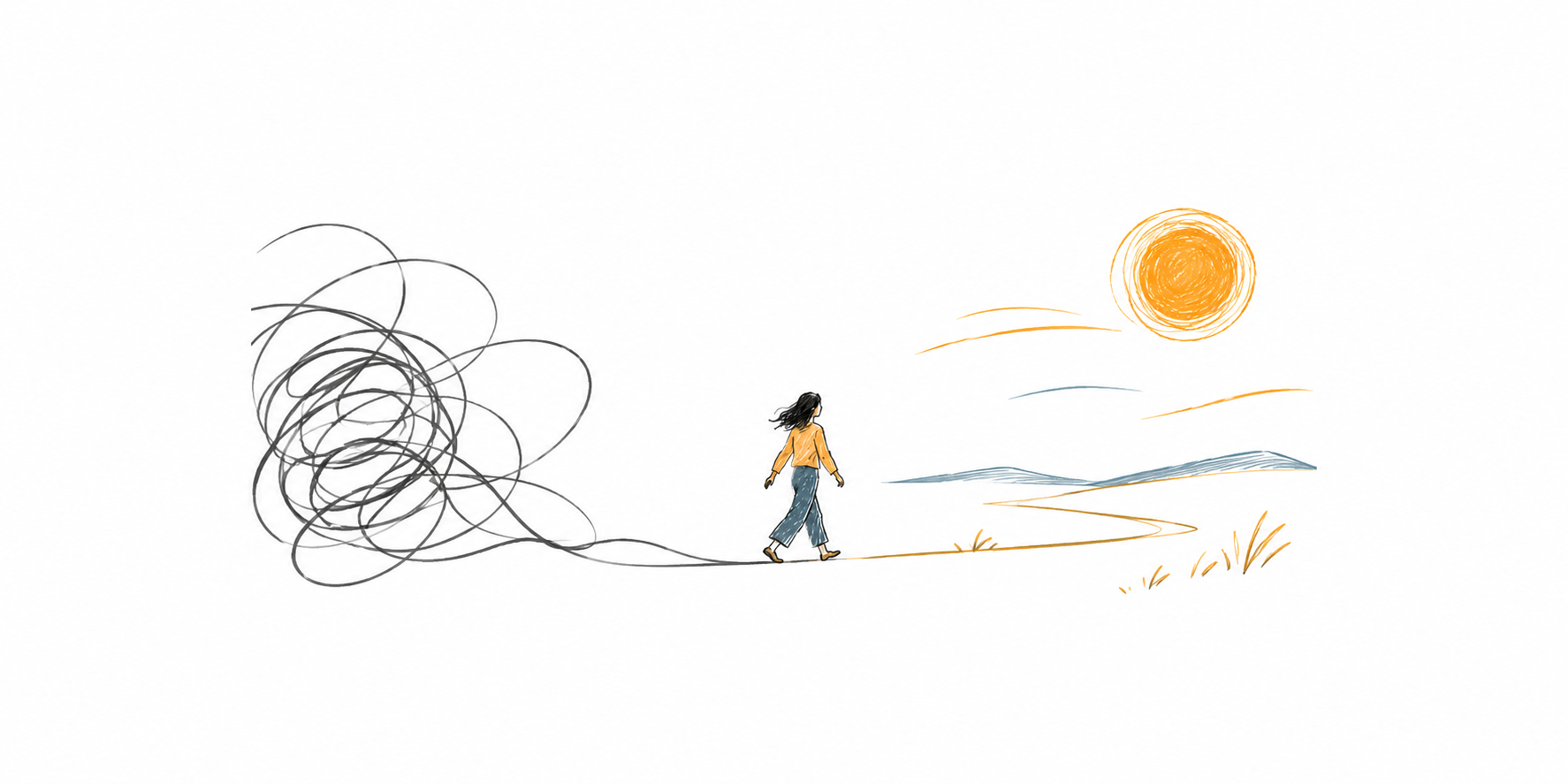
We are natural-born storytellers.
We gather fragments of our experiences and weave them into stories about who we are. The things people said. The looks they gave us. What we wanted, what we did, what we failed to do.
We revisit these memories, sometimes for decades, searching for meaning and rearranging the pieces.
And somewhere along the way, an experience can become so deeply embedded in our understanding of ourselves that we stop recognizing it as something that happened.
It becomes who we believe we are.
A relationship ends, and we become unlovable. We struggle financially, and we become incapable. We make a mistake, and rather than recognizing something we regret, we begin questioning our worth.
An experience becomes an identity.
And the identity becomes a story we keep living inside.
When Shame Enters the Story
When I was a child, my father's attention made me feel extraordinarily special.
From the outside, I appeared to have everything. Beautiful clothes, toys, gifts, and a father who seemed to adore me.
Part of me loved the excitement. The almost magical power of receiving anything I wanted.
But beneath that pleasure was something frightening.
His affection was tangled and confusing. It came with expectations and violations I was too young to understand.
In my book, Untangle, I described the gifts as having "hidden daggers and sharp edges."
There was pleasure, but there was dread.
Something was wrong, yet I had no way to make sense of the contradiction.
When I was thirteen, I began experiencing the excitement of loving a boy my own age. For the first time, I felt the pull of a life that belonged to me.
I knew I needed to end the inappropriate relationship my father had created.
I confronted him. I demanded that it stop.
His response was violence, humiliation, and rejection.
He assaulted me, expelled me from our home, and called me a devastating name.
I was thirteen.
I had asserted a boundary, and the person who was supposed to protect me responded by making me feel disposable.
At the end of that chapter in Untangle, I wrote:
"I was thirteen, and I knew the truth. I was a whore."
Of course, this wasn't the truth.
I was a child who had been violated and then punished for saying no.
But the accusation lodged itself so deeply inside me that I could no longer distinguish my father's judgment from my own understanding of who I was.
His words became my shame.
And shame began shaping my story.
The Stories We Learn to Live Inside
Shame has a peculiar ability to turn an experience into a verdict.
Guilt often concerns something we've done. Shame reaches into the self.
I made a mistake becomes I am a mistake.
I was rejected becomes I am unworthy of love.
And sometimes we carry shame for things that were never our responsibility.
A child can feel responsible for an adult's inappropriate behavior. Someone who has been mistreated can begin believing that their own desires, needs, or boundaries caused the mistreatment.
The feeling can be convincing even when the conclusion is untrue.
Over time, these beliefs begin influencing the roles we adopt.
In my own life, I learned to inhabit the good girl, the bad girl, the rebel, and the martyr.
Each role seemed to offer something.
The good girl sought approval. The rebel resisted control. The martyr found meaning in sacrifice.
But beneath these different identities lived a familiar story of shame and unworthiness.
I was capable, ambitious, and outwardly successful in many areas of my life.
Yet I could still become trapped in the belief that something was fundamentally wrong with me.
This is one of the difficulties of being tangled.
We don't always recognize that we're playing a role. We experience it as our personality, our character, the truth of who we are.
And then, often without realizing it, we organize our lives around remaining consistent with that truth.
When Remembering Becomes Another Form of Suffering
For years, I carried painful memories of my father's death, my brother's death, and the decisions I made or failed to make.
I blamed myself. I blamed others.
I returned again and again to what should have happened, what could have happened, and what I might have done differently.
There was genuine suffering in these experiences.
But over time, I began recognizing that I had become captured in a particular way of remembering.
In Untangle, I wrote:
"I was captured in my own spell of unworthiness, too busy nursing on all the wrongs that had been done to me, not the ones I was creating."
This was a difficult recognition.
Because the stories we tell about our suffering can sometimes protect us from confronting our own mistakes.
And the stories that make us responsible for everything can prevent us from recognizing what was never ours to carry.
Untangling requires us to distinguish between the two.
It asks us to confront our history without accepting responsibility for someone else's behavior.
It also asks us to recognize where our familiar responses may now be contributing to our suffering.
Both require courage.
We can acknowledge what happened to us without allowing it to become the whole explanation for who we are or how we live.
What If We Approached the Story Differently?
For years, my questions often carried the sharp edges of accusation.
Why am I like this?
Why do I keep repeating these patterns?
Why can't I change?
But gradually, I began asking something different.
In my book, I described learning to move closer to my suffering and ask:
"Why are you here? Why have you come? What happened to you?"
These questions opened a different relationship with myself.
Rather than treating every uncomfortable emotion as evidence of failure, I began seeing it as something worth understanding.
A frightened part. An ashamed part. A part still organized around an experience that belonged to another time.
In the Untangle Method™, I call these familiar protective identities Tangled Parts.
The challenge isn't simply recognizing them. It's developing enough capacity to remain present with what we discover.
This is where the Organizer Self becomes important.
It helps us create the routines, boundaries, supports, and internal structure that allow us to approach difficult experiences without becoming overtaken by them.
We can learn to recognize a familiar story without immediately obeying it.
We can acknowledge a painful memory without making it the definition of our entire life.
And we can begin responding to ourselves with greater honesty and compassion.
When Other Memories Become Possible
Something unexpected happened as I continued this work.
Other memories began returning.
I remembered people who had loved and supported me. Dance teachers. Friends. Mentors. Therapists. Moments of courage, creativity, and belonging.
I remembered experiences that didn't fit the story of unworthiness I had carried for so long.
The painful memories hadn't disappeared.
But they were no longer the only ones available to me.
In Untangle, I wrote:
"The realization that this tangled part was not my entire existence. And there is freedom in acknowledging this reality."
That freedom changed my relationship with my past.
I didn't need to deny what had happened. I didn't need to create a prettier version of my history.
I needed to recover the parts of myself that had become obscured by shame.
And as those parts became available, something else emerged.
My creativity. My desire to contribute. My ability to imagine experiences beyond the ones I had already lived.
What I call the Creative Part began to find more room.
I could engage with my history rather than remain imprisoned by one version of it.
The Story Is Still Being Written
Our memories are not perfect recordings, and healing doesn't guarantee that painful experiences will lose their intensity.
But the meanings we carry can become more flexible. Our understanding of ourselves can become more complete.
We can begin recognizing the difference between an experience and an identity.
Between responsibility and shame.
Between what happened to us and what we've come to believe it means about our worth.
Perhaps the most important question isn't whether we can change the past.
We can't.
It's whether we can stop allowing one painful chapter to determine every chapter that follows.
In my book, I wrote:
"Our stories are constantly revised."
I believe that revision is part of the art of living.
We don't have to eliminate the painful pieces of ourselves to become whole.
We can begin recovering the other pieces—the ones that remember love, beauty, courage, creativity, and possibility.
And as we do, the story expands.
Healing isn't always about telling ourselves a different story. Sometimes it's about recovering enough of ourselves to recognize that the story we've been living inside was never the whole story.
Angela McKinney is the author of Untangle: How to Create Big Possibilities Through Small Changes and creator of The Untangle Method™.